


Envirosafe Field Files
The Lady with the
Yellow-Legged Hornets
Case 191 · Mount Holly, NC
A homeowner called about the invasive hornet North Carolina had just confirmed. What was living in her cornice was something else.
Watch Case 191 · 2 min 40 sec
Nest removal in Mount Holly, Gaston County, North Carolina. Narrated field report.
Listen to Case 191 · 2 min 40 sec
Narrated field report from Mount Holly, Gaston County, North Carolina.
She called it in in a panic.
She had read that invasive yellow-legged hornets had established in Charlotte, and she was not wrong. In July the North Carolina Department of Agriculture confirmed the state's first established population of Vespa velutina in Matthews, right on the Union and Mecklenburg county line. It made the news, and it should have. That hornet is a serious predator of honeybees.
So when a homeowner in a lakeside community at Mountain Island called with a Mount Holly address and a nest packed into her cornice, we took it seriously. This was going to be EnviroSafe's first yellow-legged hornet call.
It wasn't.
Running the lineup: what a yellow-legged hornet looks like
A yellow-legged hornet is mostly black. Black thorax. Black head with a yellow face. The first three abdominal segments are black and the rest is yellow. And the feature it is named for: black legs with bright yellow tips, like it stepped in paint. A worker runs about six tenths of an inch.
What was flying out of that eave was none of that.
Reddish-brown thorax. Reddish-brown and yellow head. A yellow abdomen with rows of black teardrops running down it. Brown legs, all the way to the feet. And it was big. A solid inch, easy.
Not a yellow-legged hornet. Not close.
Ruling out the usual suspects
Cicada killer. Solitary, not colonial. All bark. A gentle giant that digs holes in the yard and never touches the structure. Homeowners panic over these every summer and they almost never need treatment.
Bald-faced hornet. Black and white, builds the gray paper football hanging from a limb. Not a true hornet at all, despite the name.
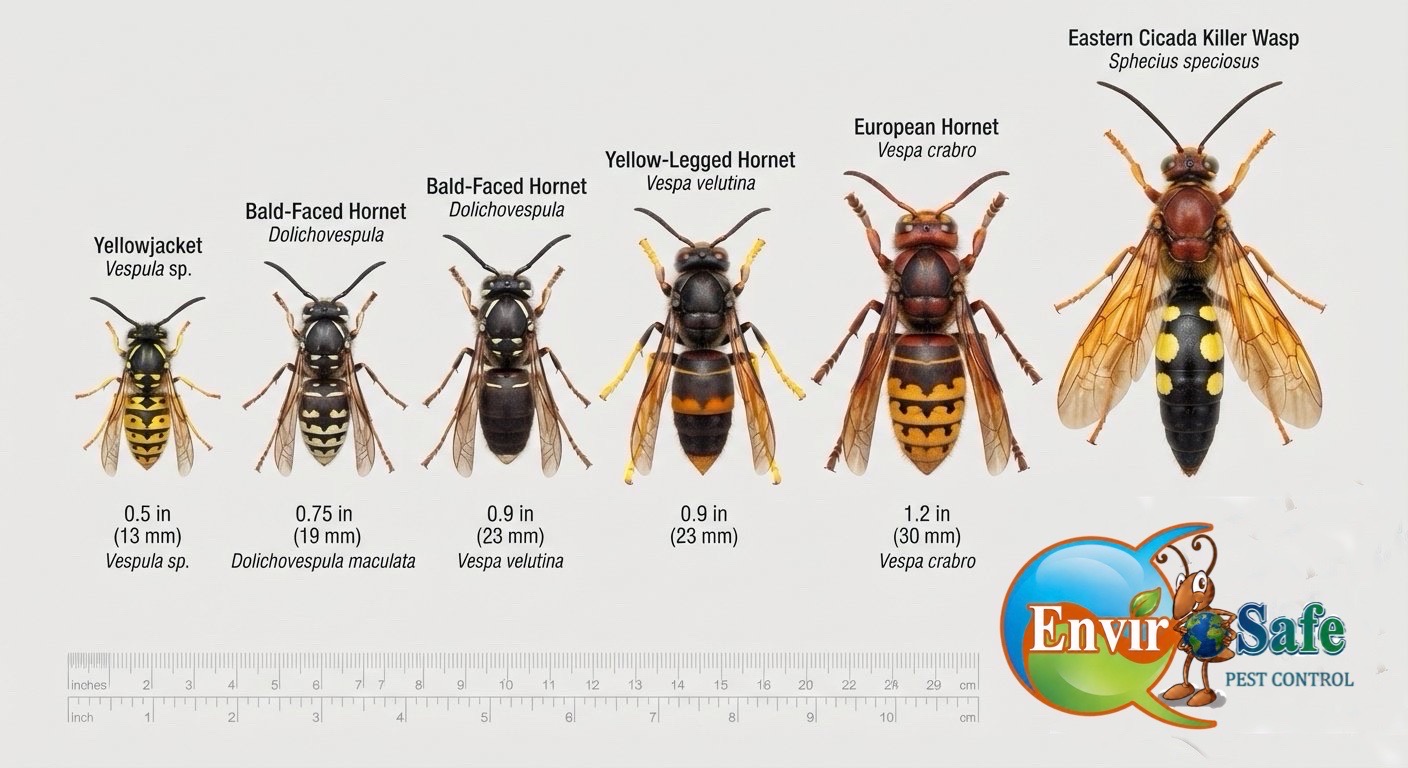
That left one suspect. The only true hornet established in the Carolinas: the European hornet, Vespa crabro. Big, brown-legged, and unusual among stinging insects because it flies at night.
The damage: a European hornet nest inside the soffit
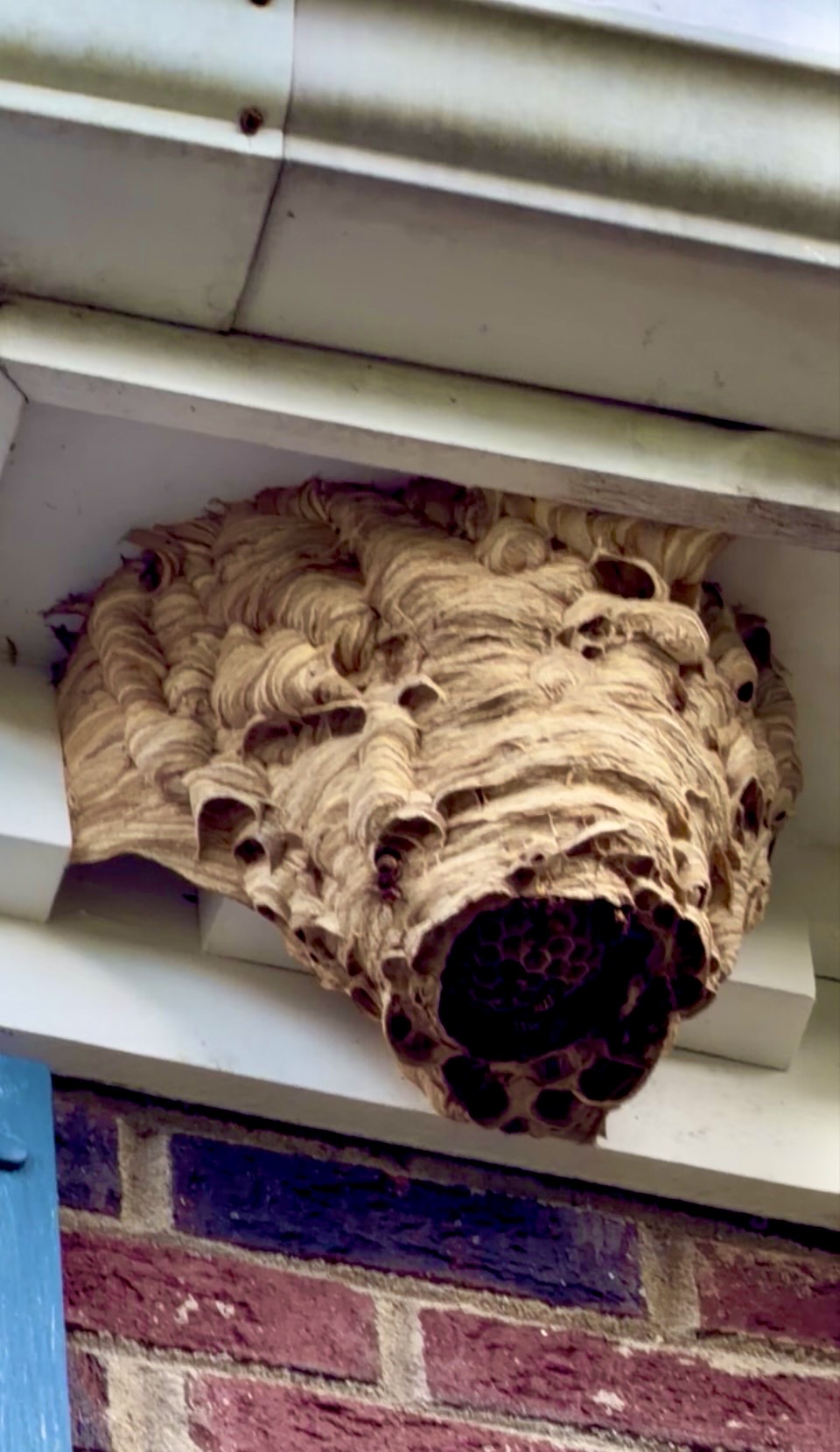
This colony had chewed clean through the crown molding and packed the cornice. The exposed face measured about fifteen inches across and nine inches tall, bigger than a basketball, with another fifteen inches of nest running back inside the soffit.
Her lamp was on at night. European hornets are drawn to light, which is why she kept seeing them at her bedroom window after dark. That is not typical wasp behavior and it is one of the fastest ways to tell you are dealing with this species.
Nest removed. Structure treated. Case closed.

Tell them apart: yellow-legged hornet vs European hornet
Field identification, side by side
| Yellow-legged hornet | European hornet | |
|---|---|---|
| Thorax | Black | Reddish-brown and black |
| Head | Black with a yellow face | Reddish-brown and yellow |
| Abdomen | First three segments black, rest yellow | Yellow with rows of black teardrops |
| Legs | Black with bright yellow tips | Brown throughout |
| Flies at night | No | Yes |
| In North Carolina | Confirmed July 2026, Matthews | Long established statewide |
If you think you found one in North Carolina
Do not knock the nest down. Do not spray it and walk away.
Report it to the North Carolina Department of Agriculture at ncagr.gov/YLH. The state is running survey traps and working to find and eliminate nests, and a confirmed report from a homeowner is genuinely useful to them.
Then call us and we will identify what is actually in your wall. Across Gaston, Mecklenburg and York counties, nine times out of ten it is a European hornet, a yellowjacket or a paper wasp, and every one gets handled differently. See stinging insect control for how we work each one, or the Mount Holly page if that is your town.
Know your suspects. Not knowing the species and the behavior is how people end up in the ER.
Common questions
Are yellow-legged hornets in North Carolina?
Yes. In July 2026 the North Carolina Department of Agriculture confirmed the state's first established population of Vespa velutina in Matthews, on the Union and Mecklenburg county line. If you think you have found one somewhere else in the state, report it at ncagr.gov/YLH.
How do you tell a yellow-legged hornet from a European hornet?
Look at the legs and the thorax. A yellow-legged hornet has a black thorax, a black head with a yellow face, and black legs tipped in bright yellow. A European hornet has a reddish-brown and black thorax, brown legs all the way to the feet, and a yellow abdomen marked with rows of black teardrops.
Why are hornets flying at my window at night?
European hornets are drawn to light and fly after dark, which is unusual for wasps. Yellow-legged hornets do not fly at night. Hornets hitting a lit bedroom window after dark almost always means European hornets.
How big does a European hornet nest get inside a soffit?
The Case 191 nest had an exposed face about fifteen inches across and nine inches tall, with another fifteen inches running back inside the soffit. The colony chewed through the crown molding to get there, so what you can see from the ground is usually a fraction of the nest.
What should I do if I find a hornet nest on my house?
Do not knock it down and do not spray it and walk away. If you think it is a yellow-legged hornet, report it to the NC Department of Agriculture first. Then call Envirosafe at 704-860-2041 and we will identify the species and treat the structure. We cover Gaston, Mecklenburg and York counties.